The choice of an international destination for higher education defines the individual’s personal development, academic path and career opportunities. The modern educational market offers many directions. Thus, the definition of the perfect destination is crucial for the long-term effectiveness. Trends in international mobility indicate that more than six million students are living outside their home countries, studying for the best degrees and developing cross-cultural skills.
There are a few key things to think about when looking at today’s landscape. Cost of the program, prestige of the school, work permit policies after graduation, and the comfort of the area. This in-depth analysis contains a detailed breakdown of the top destinations, giving would-be applicants a structured roadmap to an informed, strategic choice.
The Developing Landscape of Higher Education Globally
Major shifts in global learning environments. Traditional academic hubs are revamping visa regimes, and strong competitors are emerging in continental Europe and Asia. Universities are no longer just places where you go to listen to lectures. They are international centers for getting a head-start in your career, learning a new language and meeting like-minded people.
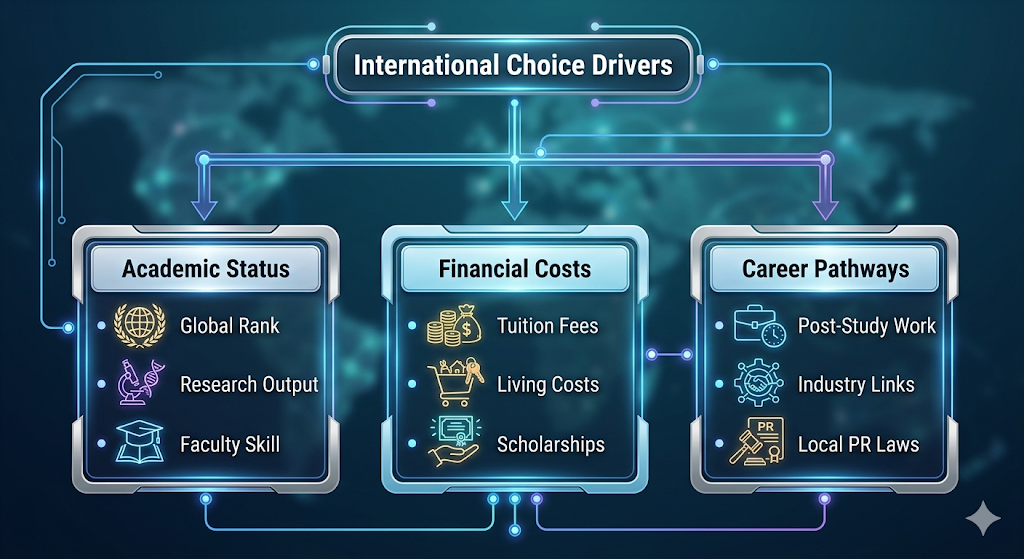
By assessing these factors for prospective candidates, you guarantee that financial pledges align with career objectives. Let’s explore the top destinations leading the way in global learning.
1. United States: World Leader in Research and Innovation
The North American academic model continues to be the preferred route for corporate and technical research. It continues to pull in large numbers of global applicants with a vast array of collegiate choices.
Best Academic Infrastructure
The country has an unparalleled concentration of top institutions. From old private associations to sprawling public systems, campuses are still flush with corporate dollars and high-tech lab spaces.
The Ivy League Advantage: Great schools with big resources, star faculty panels and powerful alumni networks in the corporate world.
State University Systems: Big networks like the University of California provide strong research programs at lower costs than their private counterparts.
Dedicated Tech Centers: World-class engineering, AI and software development universities at the forefront.
Diversity of Academics and Active Learning
The local curriculum is characterized by flexibility. The domestic system allows you to do a wide range of subjects before specializing . Many systems require early specialization . This liberal arts approach fosters versatile skill sets that are prized by corporate recruiters around the globe.
Optional Practical Training & STEM Extension)
Optional Practical Training (OPT) allocations support career progression. Typical graduates have a twelve-month window to work, but those who complete Science, Technology, Engineering or Mathematics (STEM) courses can get a twenty-four-month extension, which can allow them to be placed with top multinationals for multiple years.
2. The UK: Fast-Track Degrees and Historic Prestige
The British landscape combines centuries of heritage with modern teaching frameworks to provide an efficient route to recognised qualifications.
Strategic Effectiveness of Program Length
One major advantage of studying here is shorter program duration. Bachelor’s courses are usually three years in duration, and the normal master’s course is of twelve months. This affordable design reduces the cost of living and hastens the transition into the workforce.
Integration and Support Structures in Culture
The way the campus works is improved to help foreign learners when they come. Campuses make sure students have support—from embedded writing labs to mental-well-being structures. Historic student unions offer rich social communities, which allow newcomers to fit into local traditions seamlessly.
3. Germany: Excellent Public Education Free of Charge
A Central European industrial giant, this is a strong contender for those seeking a great education without the exorbitant debt.
Framework for Public Universities
The most prominent aspect of this system is the absence of tuition fees in almost all federal states for public institutions, regardless of the nationality of the applicant. Attendees only pay a small semester contribution for administration and public transport tickets.
University Options in Applied Sciences (Fachhochschulen)
The education system makes a distinction between traditional research institutions and Universities of Applied Sciences (Fachhochschulen). These pragmatic hubs focus on job readiness and work with industrial companies to offer necessary corporate internships and hands-on project work.
Economic stability and retention post-graduation
The country has Europe’s biggest economy and stable career opportunities in engineering, manufacturing and technology. International students can apply for an eighteen-month job search visa to look for suitable employment upon graduation.
4. Australia: Practical Career Integration and Standards of Global Lifestyle
This country is marketed as a premier southern hemisphere location that combines world-class educational frameworks with a desirable outdoor lifestyle.
The Focus of Modern Research
Local institutions score very high on the global stage, especially in the areas of environmental sciences, marine biology, healthcare and mining infrastructure. Modern campus designs focus on collaborative learning environments and digital resources.
Regional Growth Alignments
Local policies designed to counter demographic patterns reward people who settle outside major cities such as Sydney and Melbourne. Studying in regional centres such as Adelaide, Brisbane or Perth is rewarded with longer post-study work authorisation and extra points for residency applications.
5. Canada: Open Doors and Diverse Societies
This North American country is reputed for welcoming immigration and for its inclusive social systems, making it a top contender for long-term career planning.
Post-Graduation Work Permit (PGWP) structure
The local education system is tightly connected with its immigration channels. If you graduate from a designated learning institution, you may be eligible for a Post-Graduation Work Permit (PGWP). This open work authorization is valid for up to three years, comparable to the length of the academic program and provides an opportunity to gain regional professional experience.
Dual System of Institutions Universities and Colleges
The higher education sector comprises both big research universities and practical community colleges:
- Universities: Emphasis on academic theory, research, and post-graduate professional paths.
- Community Colleges: Offer quick diplomas and technical certificates for immediate local job openings.
This two-tier system allows applicants to choose a route that suits their academic style and financial budget.
6. The European Continental Transition: France and the Netherlands
European options are becoming more popular as the cost of living is competitive and options in English are expanding.
The Netherlands: Classrooms of English in Research
Dutch institutions were among the first to offer complete degree paths entirely in English in continental Europe. Centers have a reputation for problem-based learning models in which participants are asked to solve real-world case studies in groups.
France: Top Grand École’s & Cultural Wealth
In addition to the normal public systems, the country has the Grandes Écoles system of elite associations that produce world-class managers, scientists, and political leaders. Public university fees are cheap and the state subsidizes housing (APL). The country is very attractive for students on a budget.
Selection Matrix: Strategic
The following comparison chart will assist you in structuring your planning by showing the main operational aspects of each destination.
| Destination Country | Primary Tuition Cost Profile | Average Living Expenses (Annual) | Post-Study Work Window | Primary Intake Seasons |
| United States | High ($30,000 – $60,000) | $15,000 – $22,000 | 12 – 36 Months (STEM) | Fall (August), Spring (January) |
| United Kingdom | Medium-High (£15,000 – £35,000) | £12,000 – £18,000 | 24 – 36 Months (PhD) | Autumn (September), January |
| Germany | Minimal (Public Universities) | €11,000 – €13,000 | 18 Months | Winter (October), Summer (April) |
| Australia | Medium-High ($25,000 – $45,000) | $20,000 – $25,000 | 2 – 4 Years (Varies) | Semester 1 (February), Semester 2 (July) |
| Canada | Medium ($20,000 – $40,000) | $15,000 – $19,000 | up to 3 Years (PGWP) | Fall (September), Winter (January) |
| Netherlands | Medium (€10,000 – €22,000) | €12,000 – €15,000 | 12 Months (Orientation Year) | September |
Important Steps: Academic Move
Turning an international study plan into reality requires systematic preparation. Missing a deadline or misinterpreting document standards can delay an application cycle.
Step 1: Institutional and Program Evaluation
Begin your search 12 months prior to when you want to start. Be aware of program requirements, especially prerequisites, minimum GPA, and portfolio requirements for creative fields.
Step 2. Language and Standardized Testing
Book your language tests (like IELTS or TOEFL) and academic tests (like GMAT or GRE) early. If your first scores don’t meet institutional cutoffs, give yourself time for a second attempt.
Step 3: Assemble Academic Portfolio
- Collect your academic documents such as:
- Certified transcripts of all completed secondary and tertiary education.
- A well defined Statement of Purpose (SOP) about your academic background and future goals.
Letters of Recommendation (LORs) from professors/ managers who can endorse your skills.
Step 4: Verify Budget and Fiscal Compliance
Proof of adequate funds is required by visa authorities. You will need to demonstrate you have enough money to pay for your tuition fees and your basic living expenses, and that you will not need to seek employment in the country you are going to study in. This can be proved by blocked accounts, bank statements or approved educational loans.
How to Successfully Navigate Academic Transitions
In moving to a new country there are adjustments outside the classroom as well. You have to consciously balance your academic workload while adjusting to a different lifestyle.
Nurturing Intercultural Agility
You get to work with different student populations and see different perspectives and styles. Joining campus clubs, volunteering and attending local events help build cross-cultural communication skills, which are highly prized by global companies.
Access to Institutional Resources
International student offices are here to support you throughout your journey. They provide tips on housing, regulatory updates, health choices and mental wellness resources so you can navigate campus life with confidence.
Strategic Options for an International Career
International education is a considerable investment in your personal and professional development. Assessing institutional systems, cost structures and post-study prospects can help you select a path that aligns with your long-term goals. Successful global careers are built on careful planning as you work through these steps.
Complete Analytical Glossary
- Countries of Study: The foreign countries selected by persons to undertake formal academic degrees, professional certificates, or advanced research training outside of their home countries.
- Students Studied: The worldwide total of individuals who have completed international academic programs, resulting in data that informs current enrollment trends.
- World Class: Institutions or programs scoring high on research output, faculty prestige, quality of instruction and international diversity measures.
- International Student: A student who enters another country on a temporary visa to study in a formal program of higher education at an approved university or college.
- United States: A long-time destination for global education, with plentiful research funding, adaptable program choices and wide corporate recruiting networks.
- Ranked Universities: Universities ranked by global ranking systems such as QS or Times Higher Education, who rank academic reputation and research citations using explicit metrics.
- Indian Students: As the largest segment of the student population in the world, Indian students are globally recognized for their pursuit of higher education in STEM, business management and healthcare fields.
- Best Countries to Study Abroad Best countries for international students, ranked by institutional quality, pathways to careers, visa accessibility and overall value.
FAQs
Germany is one of the few countries in the world where higher education at public universities is free of charge in almost all of the federal states, only an administrative fee per semester has to be paid. Many other European countries ( Austria , Norway , and Finland among them ) have free or very inexpensive tracks at public universities , especially for those who finish their studies in the local language of the host country .
Post-study work rules vary widely by destination. STEM graduates get 12 to 36 months of practical training in the US with the OPT program. In the UK, there is a standard 2 year graduate route. Canada has a PGWP route of up to 3 years. Germany allows graduates an 18 month window to find a qualifying professional position.
Top universities require high language proficiency scores to make sure that international students cope with academic workloads and can engage in advanced research and work effectively in group assignments. Meeting these test standards can help reduce academic drop-out rates and better prepare students to adjust to their new campus environments.
European hubs attract students with lower tuition fees, shorter program formats and reasonable living costs. Many cities in continental Europe have huge public transport systems and subsidized student housing, making it easier to live on a budget while getting a degree recognized around the world.
Major industrial centers in the United States, the United Kingdom and Germany have institutions with strong corporate placement statistics. Campuses located near technology centers or industrial zones benefit from close corporate partnerships, providing direct access to internships, practical research projects, and post-graduation job opportunities.
Most global institutions have international student offices that provide academic tutoring, writing labs, housing assistance and cultural integration programs. Many campuses also have active Indian student associations that offer a familiar community, peer mentoring and helpful hints for navigating local life to new students.